
A robotic welding machine is an automated system designed to perform welding operations with programmed movements and controlled parameters. It is used in industries where consistent weld quality, repeatable production and accurate positioning are important. Robotic Welding Systems combine industrial robots with welding equipment, fixtures, sensors and safety controls. Understanding how these systems work can help manufacturers evaluate their applications, components and operational requirements.
1. Understanding Robotic Welding Machine
A robotic welding machine uses a programmable industrial robot to carry out welding operations on metal components. Instead of relying entirely on manual movement, the robot follows a defined path while the welding equipment controls the joining process.
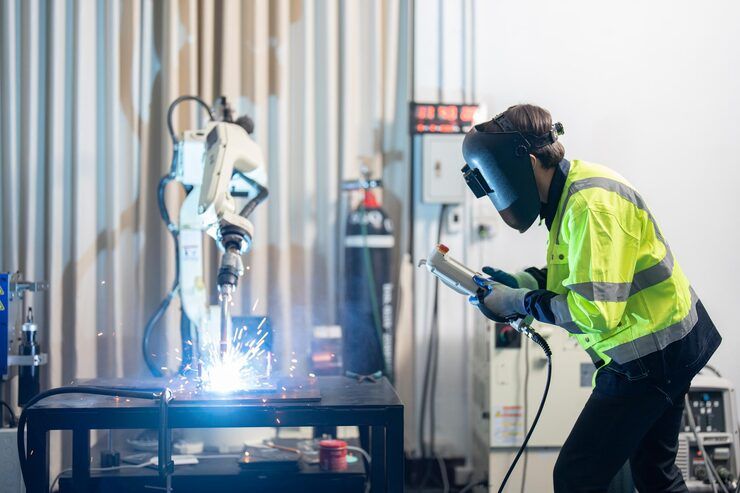
These machines are commonly used for repetitive tasks involving similar components, dimensions and welding positions. A typical installation includes a robotic arm, welding torch, power source, wire-feeding equipment, workholding fixtures and a control system.
Robotic welding can support different processes, including gas metal arc welding (GMAW), gas tungsten arc welding (GTAW), resistance spot welding and laser welding. The appropriate process depends on material type, thickness, joint design and production requirements.
A complete installation is more than a robot arm. The equipment, software, workpiece positioning and safety arrangements must operate together to produce reliable results.
2. Importance in Modern Manufacturing
Manufacturers use robotic welding to manage repetitive joining operations and maintain consistent production processes. In applications with high production volumes, programmed movement can reduce variations associated with manual positioning.
Its importance can be understood through several operational factors:
Repeatability: Programmed paths help maintain similar welding movements across repeated components.
Production planning: Automated cycles can make production timing easier to estimate.
Workplace safety: Properly designed cells can separate operators from welding arcs, heat and moving equipment.
Process monitoring: Sensors and control systems can record selected welding parameters.
Complex movements: Multi-axis robots can reach different welding positions and component areas.
Robotic welding does not eliminate the need for skilled workers. Operators, programmers, engineers and maintenance technicians remain responsible for setup, inspection, troubleshooting and process control.
3. Recent Developments and Technology Trends
Robotic welding technology continues to develop through improvements in sensors, programming software, machine connectivity and automation. During 2024–2026, several developments have influenced how manufacturers plan and operate automated welding cells.
Artificial Intelligence and Sensor Integration
Modern systems increasingly use cameras, laser sensors and other monitoring devices to identify workpiece positions and observe welding conditions. These technologies can help detect deviations and support adjustments to programmed paths or process parameters.
AI-based analysis is also being explored for identifying possible weld defects and examining process data. However, inspection results still require suitable validation and quality-control procedures.
Collaborative Welding Robots
Collaborative robots, often called cobots, are designed with safety features that can support certain human-robot working arrangements. In welding applications, they may help with smaller production batches and flexible work areas.
A collaborative robot is not automatically safe to operate beside people. Welding hazards, tool movement, heat, fumes and the complete application must be assessed before selecting a safety arrangement.
Digital Monitoring and Simulation
Simulation software allows engineers to plan robot movements, examine reach limitations and identify possible collisions before physical installation. Digital monitoring can also help production teams review operating conditions and maintenance requirements.
These developments are making system planning more data-oriented, although successful implementation still depends on correct programming, equipment integration and worker training.
4. Indian Regulations and Safety Considerations
Robotic welding installations in India must be planned around applicable machinery safety, electrical safety, workplace health and environmental requirements. The exact obligations depend on the industry, installation and equipment involved.
Important considerations include:
Industrial robot safety: ISO 10218 provides an internationally recognised framework for industrial robot safety. Applicable Indian standards and current regulatory requirements should be checked for each installation.
Electrical protection: Proper earthing, insulation, electrical enclosures and emergency isolation are important.
Machine guarding: Fences, interlocked doors, light curtains or other protective devices may be required following risk assessment.
Welding fumes: Suitable extraction and ventilation help control exposure to welding fumes and gases.
Personal protective equipment: Workers may require welding helmets, gloves, protective clothing and eye protection.
Training: Operators and maintenance personnel should understand robot movements, emergency procedures and safe operating modes.
Factories must also consider applicable provisions under Indian occupational safety and factory regulations. A qualified safety professional should review the complete installation rather than treating the robot arm as an isolated machine.
5. Types and Components of Robotic Welding Systems
Different robotic welding systems are designed for specific joining methods and production requirements.
| System type | Main application | Common use |
|---|---|---|
| Arc welding robot | Continuous welding along joints | Frames and metal structures |
| Spot welding robot | Joining metal sheets at selected points | Automotive body panels |
| Laser welding robot | Focused laser-based joining | Precision metal components |
| TIG welding robot | Controlled welding of suitable materials | Thin sections and precision work |
| Collaborative welding robot | Flexible automated welding tasks | Smaller production environments |
Main Components
A complete robotic welding installation generally contains several connected components:
Robot arm: Moves the welding tool along the programmed path.
Welding torch: Applies the selected welding process to the workpiece.
Power source: Supplies the electrical or process energy required for welding.
Wire feeder: Delivers welding wire when the selected process requires it.
Positioner: Rotates or repositions the workpiece for suitable welding access.
Fixtures: Hold components in the required position during welding.
Controller: Coordinates robot movement and operating instructions.
Safety equipment: Includes guarding, interlocks and emergency-stop arrangements.
Understanding a Robot Workstation
A Robot Workstation is the organised area where the robot, welding equipment, workpiece fixtures and operator controls are installed. Its layout affects accessibility, production movement, maintenance and safety.
A workstation may use one robot with a fixed fixture or include multiple stations and rotating positioners. Some designs allow an operator to load one component while the robot works in a separate protected area.
The layout should provide enough space for robot movement, material handling, inspection and maintenance. Cable routing, fume extraction and emergency access should also be considered during the design stage.
6. Planning and Maintenance Resources
Selecting and operating a robotic welding machine requires an understanding of production needs and technical limitations. Manufacturers should review the following areas before planning an installation:
Production requirements: Identify component dimensions, material types, joint designs and expected production volume.
Welding process: Select an appropriate process based on material thickness and required joint characteristics.
Robot reach and payload: Confirm that the robot can handle the torch and reach all required welding positions.
Workholding: Evaluate fixtures and positioners for accurate component placement.
Programming: Use suitable offline or teach-pendant programming methods.
Inspection: Establish procedures for checking weld appearance, dimensions and structural requirements.
Maintenance: Inspect torches, cables, wire feeders, fixtures, sensors and safety devices regularly.
Preventive maintenance schedules should follow equipment documentation and actual operating conditions. Recordkeeping can help identify recurring faults, consumable usage and equipment downtime.
7. Frequently Asked Questions
1. What is a robotic welding machine?
It is an automated welding system that uses a programmable robot to move welding equipment along a defined path and join metal components.
2. Which industries use Robotic Welding Systems?
Common applications include automotive manufacturing, construction equipment, metal fabrication, agricultural machinery, rail equipment and industrial machinery production.
3. What is included in a Robot Workstation?
A typical workstation includes a robot arm, welding torch, power source, fixtures, controller, safety equipment and sometimes a workpiece positioner.
4. Can robotic welding handle different materials?
Yes, depending on the welding process, equipment configuration and material characteristics. Steel, stainless steel and aluminium are examples of materials used in suitable robotic welding applications.
5. Does robotic welding require skilled operators?
Yes. Trained personnel are needed for programming, setup, monitoring, inspection, troubleshooting and maintenance. Automation changes the tasks involved but does not remove the need for technical expertise.
8. Conclusion
A robotic welding machine combines industrial robotics, welding technology and control equipment to automate metal-joining operations. Its applications range from automotive production to general fabrication and industrial machinery. Selecting an appropriate system requires attention to welding processes, robot reach, fixtures, workstation layout and safety arrangements. With suitable programming, training and maintenance, robotic welding can become an integrated part of a controlled manufacturing process.