
The industrial oil and gas sector covers the technologies, equipment, facilities, and processes used to explore for, produce, process, transport, store, and refine petroleum and natural gas. It connects underground resources with refineries, power generation, chemical manufacturing, transportation, and other industrial activities.
The industry is commonly divided into three major areas: upstream, midstream, and downstream. Upstream activities focus on exploration and production. Midstream activities involve gathering, pipelines, storage, and transportation. Downstream activities include refining crude oil and processing natural gas into products and feedstocks.
Modern oil and gas operations increasingly combine petroleum engineering with industrial automation, digital monitoring, process control, data analytics, emissions measurement, and advanced materials.
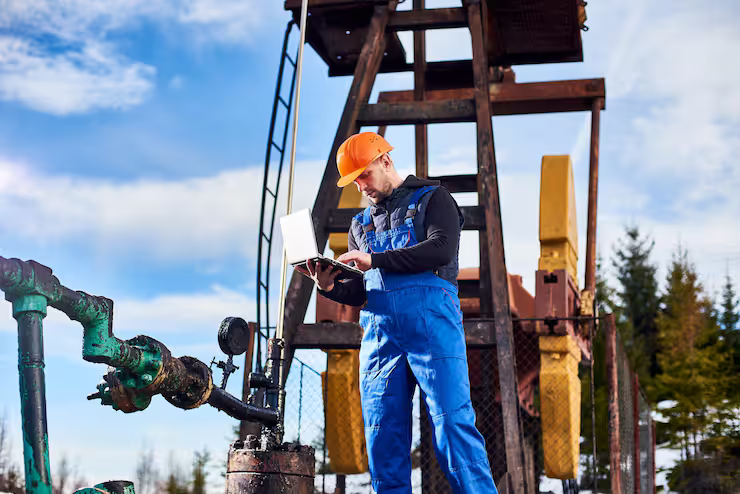
Why Industrial Oil and Gas Matters
Oil and natural gas remain important components of the global energy system and are also used as raw materials in petrochemicals, plastics, fertilizers, solvents, synthetic materials, and other industrial products.
The sector affects governments, manufacturers, transport operators, utilities, consumers, and industries that depend on reliable energy and chemical feedstocks.
Major challenges addressed by modern oil and gas technologies include:
- Efficient resource extraction
- Safe handling of high-pressure fluids
- Reliable transportation and storage
- Refinery process control
- Natural gas processing
- Methane and greenhouse gas monitoring
- Equipment reliability and predictive maintenance
- Pipeline integrity management
- Emergency response and process safety
| Industrial Area | Main Activities | Common Technologies |
|---|---|---|
| Upstream | Exploration and production | Drilling systems, seismic imaging, pumps |
| Midstream | Gathering and transportation | Pipelines, compressors, storage tanks |
| Downstream | Refining and processing | Distillation, cracking, separation |
| LNG | Gas liquefaction and shipping | Cryogenic systems, heat exchangers |
| Digital Operations | Monitoring and optimization | SCADA, sensors, analytics, AI |
Major Operations in the Oil and Gas Industry
Exploration and Drilling
Exploration uses geological studies, seismic surveys, well data, and reservoir analysis to identify potentially productive formations. Drilling equipment then creates wells through which hydrocarbons can be evaluated and produced.
Modern drilling operations can use directional drilling, measurement-while-drilling systems, logging tools, automated controls, and real-time data monitoring.
Oil and Gas Production
Production facilities separate crude oil, natural gas, water, and other substances after fluids reach the surface. Pumps, separators, compressors, valves, meters, and control systems help manage the process.
Production engineers monitor pressure, temperature, flow rates, equipment performance, and reservoir behavior to maintain stable operations.
Transportation and Storage
Pipelines are widely used for moving crude oil and natural gas between production areas, processing facilities, storage locations, refineries, and distribution networks.
Pipeline operations can include:
- Pressure monitoring
- Flow measurement
- Leak detection
- Corrosion monitoring
- Remote valve control
- Pipeline inspection
- SCADA-based supervision
Storage facilities may use above-ground tanks, underground storage systems, or specialized facilities for liquefied gases.
Refining and Processing
Crude oil contains many hydrocarbon compounds that must be separated and transformed into useful products. Refineries use processes such as atmospheric distillation, vacuum distillation, catalytic cracking, hydroprocessing, and reforming.
Natural gas processing removes water, carbon dioxide, hydrogen sulfide, natural gas liquids, and other components when required by the specification of the final gas stream.
LNG and Gas Processing
Liquefied natural gas, or LNG, is natural gas cooled to approximately −162°C so that it occupies much less volume. LNG technology requires specialized refrigeration systems, insulated storage tanks, cryogenic equipment, loading systems, and marine transportation infrastructure.
Equipment Used in Industrial Oil and Gas
Industrial oil and gas equipment ranges from large rotating machinery to small monitoring instruments.
Drilling and Production Equipment
Common equipment includes:
- Drilling rigs
- Drill pipes and bits
- Wellheads
- Blowout preventers
- Artificial-lift systems
- Pumps
- Separators
- Compressors
- Heat exchangers
- Pressure vessels
Refinery and Processing Equipment
Refineries and gas-processing plants commonly use:
- Distillation columns
- Reactors
- Fractionators
- Furnaces
- Heat exchangers
- Compressors
- Pumps
- Filtration systems
- Storage tanks
- Process-control equipment
Equipment selection depends on operating pressure, temperature, fluid composition, throughput, corrosion characteristics, and applicable engineering standards.
Technologies Transforming the Industry
Industrial Automation
Distributed control systems, programmable logic controllers, SCADA platforms, sensors, and industrial networks allow operators to monitor complex facilities continuously.
Automation can help identify abnormal operating conditions and support more consistent process control.
Digital Oilfield Technology
Digital oilfield systems combine field sensors, production data, communications networks, engineering models, and analytics. These systems can help engineers understand production performance without relying solely on periodic manual measurements.
Predictive Maintenance
Predictive maintenance uses equipment data such as vibration, temperature, pressure, flow, and operating history to identify potential equipment problems.
This approach can help maintenance teams prioritize inspections and reduce unexpected equipment interruptions.
Artificial Intelligence and Data Analytics
AI and machine learning are increasingly being studied for applications such as reservoir analysis, equipment monitoring, production forecasting, image interpretation, and anomaly detection.
These technologies do not eliminate the need for engineering judgment. Their usefulness depends on data quality, appropriate models, validation, and operational context.
Recent Industry Updates
The oil and gas sector has experienced significant changes during 2025 and 2026.
In January 2026, the International Energy Agency reported that expanding LNG supply, particularly from North America, was expected to contribute to the rebalancing of global natural gas markets.
The energy market outlook changed considerably during the first half of 2026. The IEA reported that disruption around the Strait of Hormuz affected LNG flows and created substantial uncertainty in global gas markets. Its July 7, 2026 report projected that global natural gas demand would decline by about 0.5% during 2026.
Oil demand also faced a changing outlook. The IEA's June 17, 2026 Oil Market Report projected a 1.1 million-barrel-per-day decline in global oil demand during 2026 compared with 2025, while noting an expected recovery in 2027 under its forecast assumptions.
Methane monitoring remains another major technology and policy focus. The IEA's 2026 Global Methane Tracker estimated that fossil-fuel operations accounted for a substantial share of human-caused methane emissions and reported that energy-related methane emissions had not clearly declined in 2025.
These developments are increasing attention on supply-chain resilience, LNG infrastructure, emissions measurement, energy efficiency, and digital monitoring.
Laws and Policies Affecting Oil and Gas
Oil and gas regulations differ significantly between countries and even between regions within a country. They can cover environmental protection, drilling permits, pipeline integrity, worker safety, emissions, water management, chemical handling, land use, and facility reporting.
United States Regulatory Example
In the United States, the Environmental Protection Agency has established federal requirements addressing methane and other air pollutants from oil and natural gas operations. The 2024 EPA rule included standards for new, modified, and reconstructed sources and emissions guidelines concerning existing sources.
The regulatory position changed during 2025. On July 28, 2025, EPA announced an interim final rule extending several compliance deadlines associated with the oil and natural gas methane regulations.
Another significant development involved the Waste Emissions Charge. Congress disapproved the 2024 final rule through a joint resolution signed on March 14, 2025, and EPA subsequently removed the regulation from the Code of Federal Regulations. The charge is therefore not currently in effect.
EPA also continues to administer methane-related reporting requirements under the Greenhouse Gas Reporting Program.
Companies and technical teams working in this field should verify current federal, state, and local requirements before making regulatory decisions.
Tools and Resources
Several authoritative resources can help readers understand oil and gas operations, market conditions, regulations, and technical data.
- U.S. Energy Information Administration Data Tools — Provides energy datasets, dashboards, maps, and analytical tools.
- EIA Natural Gas Data — Includes production, storage, pipeline, import, export, and consumption information.
- U.S. EPA Oil and Natural Gas Resources — Provides regulatory information related to air emissions.
- International Energy Agency — Provides global energy market analysis, oil and gas reports, and energy statistics.
- IEA Gas Market Reports — Useful for tracking LNG, natural gas demand, supply, and market developments.
Useful technical resources can also include process simulation software, pipeline monitoring systems, engineering calculators, equipment manuals, safety standards, emissions databases, and industrial data platforms.
Frequently Asked Questions
What are the three main parts of the oil and gas industry?
The three major segments are upstream, midstream, and downstream. Upstream covers exploration and production, midstream covers transportation and storage, and downstream covers refining and processing.
What equipment is commonly used in oil and gas operations?
Common equipment includes drilling rigs, pumps, compressors, separators, pipelines, storage tanks, heat exchangers, pressure vessels, valves, sensors, and industrial control systems.
How is natural gas processed?
Raw natural gas can contain water, carbon dioxide, hydrogen sulfide, natural gas liquids, and other components. Processing plants separate or remove these components so the resulting gas meets the required specifications.
What role does automation play in oil and gas?
Automation helps monitor pressure, temperature, flow, equipment status, and other operating parameters. Control systems can also support process stability and help operators identify abnormal conditions.
Why is methane monitoring important?
Methane is a potent greenhouse gas. Monitoring technologies can help identify emissions sources and provide data that supports regulatory reporting, operational analysis, and emissions-reduction programs.
Conclusion
Industrial oil and gas combines geological science, petroleum engineering, mechanical equipment, chemical processing, transportation infrastructure, and industrial automation. Its operations extend from exploration and drilling to refining, natural gas processing, LNG infrastructure, and pipeline transportation.
The industry is also becoming increasingly data-driven. Sensors, automation, predictive analytics, emissions monitoring, and digital control systems are changing how complex facilities are operated and maintained.
Recent developments in global energy markets and environmental regulation demonstrate why understanding both traditional oil and gas technologies and newer digital systems is important. Reliable technical information, current regulatory references, and established engineering practices remain essential for understanding this continually evolving industrial sector.