
Industrial discrete manufacturing is the production of individual, identifiable products or components. Unlike process manufacturing, which often produces materials continuously or in batches, discrete manufacturing creates separate physical units that can usually be counted, inspected, assembled, and tracked.
Common examples include automobiles, electronic devices, industrial machinery, appliances, medical equipment, aircraft components, and fabricated metal products.
The basic manufacturing process can involve several stages, including product design, material preparation, machining, forming, assembly, inspection, testing, packaging, and distribution.
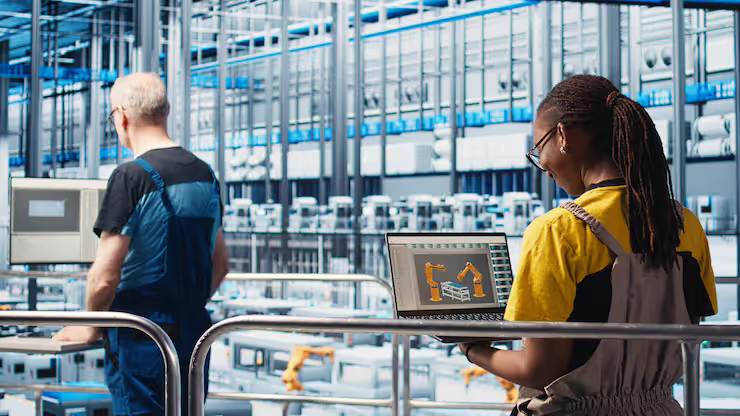
Modern discrete manufacturing increasingly combines physical production equipment with industrial automation, manufacturing execution systems (MES), enterprise resource planning (ERP), robotics, sensors, computer numerical control (CNC), artificial intelligence (AI), and industrial Internet of Things (IIoT) technologies.
How discrete manufacturing differs from process manufacturing
| Discrete Manufacturing | Process Manufacturing |
|---|---|
| Produces individual units | Produces materials continuously or in batches |
| Products can usually be counted individually | Output is often measured by volume or weight |
| Assembly is commonly important | Mixing, heating, or chemical transformation may dominate |
| Common in automotive and electronics | Common in chemicals, food, and pharmaceuticals |
| Uses bills of materials and part numbers | Often uses formulas or recipes |
The main purpose of discrete manufacturing is to transform raw materials and components into finished products that meet defined specifications.
Why Industrial Discrete Manufacturing Matters
Discrete manufacturing plays an important role in global industrial production because many everyday products depend on individually manufactured components and assemblies.
It affects manufacturers, component producers, engineering teams, logistics networks, quality departments, and consumers.
Problems it helps address
A well-organized discrete manufacturing system can help manufacturers manage challenges such as:
- Production planning and scheduling
- Product quality and consistency
- Material traceability
- Machine utilization
- Inventory management
- Production downtime
- Assembly errors
- Quality inspection
- Product customization
- Supply chain coordination
Manufacturing automation can also reduce repetitive manual activities and improve consistency when properly designed and controlled.
Major industries using discrete manufacturing
| Industry | Typical Products |
| Automotive | Vehicles, engines, transmissions, body components |
| Electronics | Circuit boards, computers, consumer devices |
| Aerospace | Aircraft structures and components |
| Machinery | Pumps, compressors, industrial equipment |
| Medical technology | Diagnostic equipment and instruments |
| Appliances | Refrigerators, washing machines, kitchen equipment |
| Metal fabrication | Frames, brackets, enclosures, structural components |
Main Types of Discrete Manufacturing
Discrete manufacturing can be organized in several ways depending on production volume, product variety, and customer requirements.
Make-to-stock manufacturing
Products are manufactured based on expected demand and maintained as finished inventory. This approach is commonly associated with standardized products and relatively predictable demand.
Make-to-order manufacturing
Production begins after a specific requirement is received. Products may have defined configurations or customer-specific characteristics.
Engineer-to-order manufacturing
The product may require engineering design or significant modification before manufacturing begins. Industrial machinery and specialized equipment are common examples.
Batch manufacturing
A defined quantity of similar products is produced during a particular production run. After one batch is completed, equipment may be adjusted for another product or configuration.
Mass production
Mass production focuses on producing large quantities of standardized products through highly organized production lines and automation.
Key Processes in Discrete Manufacturing
The exact production sequence varies by industry, but several processes appear across many manufacturing environments.
Product design and engineering
Computer-aided design (CAD) software is commonly used to create detailed product models and engineering drawings.
Engineers define dimensions, tolerances, materials, assembly relationships, and performance requirements before physical production begins.
Material preparation
Raw materials and components are prepared for production. This can include cutting, forming, casting, stamping, machining, or other preparation techniques.
Machining and fabrication
CNC machining, laser cutting, bending, welding, grinding, drilling, and other manufacturing technologies may be used to create individual components.
Assembly
Individual parts are joined to create larger assemblies. Assembly may be manual, automated, or a combination of both.
Robotic assembly systems are increasingly used for repetitive and highly controlled operations.
Inspection and testing
Quality control is an important part of discrete manufacturing. Measurement equipment, machine vision, coordinate measuring machines (CMMs), sensors, and automated inspection systems can identify dimensional or functional issues.
Packaging and traceability
Finished products may receive identification numbers, barcodes, QR codes, or other tracking information. Digital traceability helps connect products with production records, materials, inspection results, and process data.
Key Technologies in Modern Discrete Manufacturing
Technology has changed how manufacturers design, produce, inspect, and manage physical products.
Industrial automation
Programmable logic controllers (PLCs), industrial control systems, sensors, actuators, variable frequency drives, and human-machine interfaces can coordinate production equipment.
Robotics
Industrial robots can perform activities such as welding, painting, material handling, assembly, palletizing, and machine tending.
Collaborative robots, often called cobots, are designed for specific applications where humans and robots may work within the same production environment, subject to appropriate safety controls.
Manufacturing execution systems
A manufacturing execution system (MES) connects production activities with operational information. It can support production tracking, quality records, scheduling, work instructions, and traceability.
Enterprise resource planning
ERP systems connect manufacturing information with broader business processes such as inventory, procurement, production planning, finance, and supply chain management.
Digital twins
A digital twin is a digital representation of a physical product, machine, process, or production environment. It can be used to study performance, simulate changes, and analyze operational data.
Artificial intelligence and machine learning
AI and machine learning are being explored for predictive maintenance, visual inspection, production optimization, demand forecasting, anomaly detection, and process analysis.
The World Economic Forum's Intelligent Industrial Operations Outlook 2026, published on April 16, 2026, highlights a broader shift toward connected, intelligent, and increasingly autonomous industrial operations.
Recent Developments in Discrete Manufacturing
Several developments during 2025 and 2026 have increased attention on advanced manufacturing technologies.
AI and physical automation
AI is moving beyond software-based analysis into physical industrial environments. The World Economic Forum reported in July 2026 that its Global Lighthouse Network had reached 238 factories, with generative AI use cases accounting for 23% of the network's top solutions in 2025.
This indicates growing interest in combining automation, production data, robotics, and AI-based decision support.
India's advanced manufacturing roadmap
On October 29, 2025, NITI Aayog unveiled Reimagining Manufacturing: India's Roadmap to Global Leadership in Advanced Manufacturing. The roadmap identifies artificial intelligence and machine learning, advanced materials, digital twins, and robotics as important technology enablers across 13 priority manufacturing sectors.
National Manufacturing Mission
India announced the National Manufacturing Mission in the Union Budget 2025–26 on February 1, 2025. The mission focuses on areas including technology availability, quality manufacturing, MSME development, workforce readiness, and manufacturing competitiveness.
These developments show that industrial automation, smart manufacturing, robotics, AI, and digital manufacturing are becoming increasingly important areas of manufacturing strategy.
Laws, Standards, and Policies in India
Discrete manufacturing in India is affected by product standards, machinery safety requirements, environmental rules, energy-efficiency programs, and sector-specific regulations.
Machinery safety standards
The Bureau of Indian Standards (BIS) maintains standards related to machinery safety, including risk assessment, machine control systems, safety guards, interlocks, and integrated manufacturing systems. BIS also provides machine-safety certification guidance under Scheme-X.
A 2025 BIS draft standard, IS 15296:2025, addressed the integration of machinery into systems and was aligned with ISO 11161:2025.
Machinery and electrical equipment requirements
BIS information updated in April 2026 includes certification requirements and applicable standards for categories of machinery and electrical equipment under India's regulatory framework.
Manufacturers should verify the latest applicable notification, standard, and conformity requirements for their specific equipment and product category.
Energy efficiency
Energy-intensive industrial operations may also be affected by India's energy-efficiency framework. The Bureau of Energy Efficiency's 2025 Perform, Achieve and Trade information lists 1,333 covered energy-intensive industries and reports substantial aggregate energy savings under the program.
Useful Tools and Resources
Manufacturing professionals can use several categories of tools to understand and manage discrete manufacturing operations.
- CAD software: Used for product design, engineering drawings, and 3D modeling.
- CAM software: Helps translate product designs into manufacturing instructions for CNC equipment.
- ERP systems: Support production planning, inventory, procurement, and operational records.
- MES platforms: Provide production-floor tracking, quality information, and traceability.
- CNC programming tools: Help prepare machining operations and production instructions.
- OEE calculators: Help evaluate equipment availability, performance, and quality.
- BIS standards database: Useful for checking applicable Indian Standards and related documents. BIS's “Know Your Standard” portal allows searches by standard number or keyword.
- BEE resources: Useful for understanding industrial energy-efficiency programs and related information in India.
- Digital twin platforms: Can support simulation and analysis of products, machines, and production systems.
- Industrial data dashboards: Help visualize production, quality, downtime, and equipment information.
Frequently Asked Questions
What is discrete manufacturing?
Discrete manufacturing produces individual, identifiable products or components. Examples include vehicles, electronic devices, industrial machinery, appliances, and aircraft components.
What is the difference between discrete and process manufacturing?
Discrete manufacturing creates separate physical units, while process manufacturing generally produces materials through continuous or batch-based processes. Automotive production is a typical discrete example, while chemical production is commonly associated with process manufacturing.
What technologies are used in discrete manufacturing?
Common technologies include CNC machines, industrial robots, PLCs, sensors, machine vision, MES, ERP, CAD/CAM, digital twins, IIoT platforms, and artificial intelligence.
How does automation affect discrete manufacturing?
Automation can improve repeatability, production monitoring, material handling, inspection, and machine coordination. Its effectiveness depends on appropriate system design, maintenance, worker training, and safety controls.
Is discrete manufacturing suitable for customized products?
Yes. Technologies such as flexible manufacturing systems, CNC machining, digital production planning, and configurable assembly systems can support different product variants and smaller production runs.
Conclusion
Industrial discrete manufacturing is centered on producing identifiable products and components through coordinated engineering, fabrication, assembly, inspection, and production management activities.
Its technology landscape is expanding from traditional automation toward connected manufacturing systems that combine robotics, industrial data, AI, digital twins, machine vision, MES, and ERP platforms.
In India, recent policy developments such as the National Manufacturing Mission and NITI Aayog's 2025 advanced manufacturing roadmap demonstrate continued attention to technology-driven industrial development.
For manufacturers, understanding production processes, machinery safety, quality requirements, energy efficiency, and digital technologies provides a useful foundation for evaluating how modern discrete manufacturing systems operate.