
Industrial automotive manufacturing is the organized process of designing, producing, assembling, testing, and validating vehicles and their components. It combines mechanical engineering, electronics, robotics, materials science, software, quality management, and industrial automation.
Modern vehicle production involves much more than assembling engines and body panels. Manufacturers may work with internal-combustion engines, hybrid systems, electric motors, battery packs, electronic control units, sensors, software, safety systems, and connected technologies.
A typical automotive manufacturing process moves through several stages:
- Product design and engineering
- Material preparation
- Stamping and forming
- Machining
- Welding and body assembly
- Painting and surface treatment
- Powertrain or battery assembly
- Final vehicle assembly
- Software configuration
- Inspection and testing
- Quality verification
Automation plays an important role throughout these stages. Industrial robots can perform repetitive welding, material handling, painting, and assembly tasks, while machine-vision systems can inspect components for dimensional or surface defects.
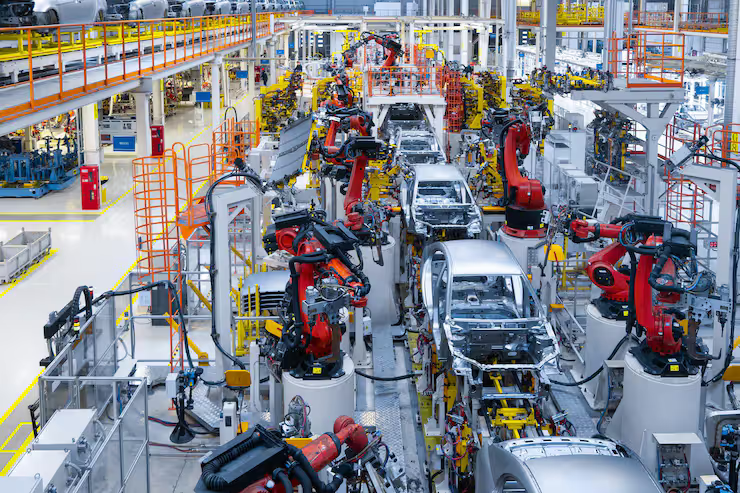
Why Automotive Manufacturing Matters Today
Automotive manufacturing affects transportation, industrial supply chains, electronics, metals, plastics, batteries, logistics, and energy systems. A vehicle contains thousands of individual components, making automotive production one of the most interconnected manufacturing activities.
Manufacturing technology also helps address several important challenges:
- Maintaining consistent product quality
- Improving production accuracy
- Reducing material waste
- Managing complex component supply chains
- Supporting electric and hybrid vehicle production
- Meeting vehicle safety and emissions requirements
- Integrating software with mechanical systems
- Improving factory energy efficiency
The shift toward electric vehicles is particularly significant. EVs generally use simpler mechanical drivetrains than conventional vehicles, while requiring greater integration of batteries, power electronics, sensors, and software. The International Energy Agency reported that nearly 22 million electric cars were produced globally in 2025, more than 25% higher than in 2024.
Key Technologies Used in Automotive Production
| Technology | Typical Application |
|---|---|
| Industrial robotics | Welding, painting, assembly, handling |
| CNC machining | Precision engine and component manufacturing |
| Machine vision | Automated inspection |
| CAD/CAM | Product design and manufacturing preparation |
| Industrial IoT | Machine and production monitoring |
| Digital twins | Process simulation and optimization |
| Automated guided vehicles | Factory material movement |
| Battery manufacturing equipment | Cell, module, and pack production |
| MES platforms | Production tracking and manufacturing data |
| AI analytics | Quality monitoring and predictive analysis |
Recent Automotive Manufacturing Trends
Automotive production has changed significantly during 2025 and 2026, particularly in EV manufacturing, software, automation, and battery technology.
Growth of Electric Vehicle Manufacturing
The 2026 IEA Global EV Outlook reported record global electric-car production in 2025. China remained the largest manufacturing hub, accounting for about 70% of global electric-car production and more than 80% of battery-cell production.
This concentration has increased attention on battery materials, semiconductor availability, regional manufacturing capacity, and supply-chain resilience.
Software-Defined Vehicles
A major development is the growth of software-defined vehicles. In its report published May 20, 2026, the IEA noted that vehicle functionality is increasingly controlled through centralized software architectures.
This changes automotive manufacturing because production now involves software configuration and electronic validation alongside traditional mechanical assembly.
Important areas include:
- Centralized vehicle computing
- Over-the-air software updates
- Advanced driver-assistance systems
- Battery-management software
- Automotive cybersecurity
- Electronic control systems
More Automation and AI
Artificial intelligence and machine learning are increasingly being applied to quality inspection, factory monitoring, production planning, robotics, and predictive maintenance.
Machine vision can identify inconsistencies that may be difficult to detect through manual inspection, while factory data can help engineers understand equipment performance and production bottlenecks.
Automotive Manufacturing Laws and Policies in India
Automotive manufacturing in India is influenced by vehicle safety, emissions, type-approval, environmental, and manufacturing policies.
Central Motor Vehicles Rules and AIS Standards
The Central Motor Vehicles Rules provide an important regulatory framework for motor vehicles in India. Automotive Industry Standards are developed through the Automotive Industry Standards Committee under the CMVR technical framework. ARAI maintains published AIS standards covering areas such as vehicle safety, testing, and technical requirements.
Manufacturers therefore need to consider applicable technical requirements during vehicle development, testing, and homologation.
Bharat Stage VI Emission Requirements
Bharat Stage VI requirements regulate emissions from applicable vehicles and engines. Relevant AIS documentation covers areas including gaseous and particulate pollutants, onboard diagnostics, in-service emissions, and emission-control durability.
These requirements influence engine design, exhaust after-treatment, electronic controls, testing, and manufacturing validation.
Bharat New Car Assessment Program
India's Bharat New Car Assessment Program provides a structured framework for assessing vehicle safety. AIS-197 establishes the Bharat New Car Assessment Program framework under the automotive standards system.
Safety assessment has increased the importance of crashworthiness, occupant protection, restraint systems, structural design, and electronic safety technologies.
PLI-Auto
The Production Linked Incentive Scheme for Automobile and Auto Components focuses on Advanced Automotive Technology products and supports deeper domestic manufacturing of technologies such as electric vehicles and advanced components. The scheme has a budgetary outlay of ₹25,938 crore and applies during FY2022–23 through FY2026–27, with subsequent incentive disbursement.
As reported by the Government in July 2026, approved applicants had reported ₹44,326 crore in cumulative investment through March 31, 2026, while 67,820 employment positions were reported as generated under the scheme.
PM E-DRIVE
The PM E-DRIVE program supports electric mobility, charging infrastructure, and related automotive manufacturing activities. In August 2025, the government extended the scheme's overall tenure to March 31, 2028, although certain vehicle-category terminal dates remained earlier.
These policies contribute to the changing production landscape for EVs, batteries, charging infrastructure, and automotive testing.
Tools and Resources for Automotive Manufacturing
Several technical resources help students, engineers, researchers, and manufacturing professionals understand automotive production.
Useful Resources
- ARAI Automotive Industry Standards: A reference for Indian automotive standards, technical requirements, and regulatory information.
- ARAI Homologation Resources: Provides information about vehicle testing, certification, and regulatory activities.
- IEA Global EV Outlook: Provides current information about electric-vehicle production, batteries, technology, and global automotive trends.
- IEA Global EV Data Explorer: Useful for reviewing EV-related historical and projected data.
- PM E-DRIVE Portal: Provides official notifications, guidelines, and updates concerning India's electric-mobility program.
Common Engineering Tools
Automotive manufacturing teams may also use:
- CAD software for vehicle and component design
- CAM software for machining preparation
- Finite element analysis for structural simulation
- Manufacturing execution systems for production information
- Enterprise resource planning platforms for manufacturing planning
- Statistical process control tools for quality analysis
- Digital-twin platforms for production simulation
- Battery-management and testing systems for EV development
The appropriate tool depends on the manufacturing stage, product type, production volume, and regulatory requirements.
Frequently Asked Questions
What is industrial automotive manufacturing?
Industrial automotive manufacturing is the large-scale engineering and production process used to create vehicles and their components. It includes design, machining, forming, welding, painting, assembly, software integration, inspection, and testing.
What are the main stages of vehicle manufacturing?
The major stages generally include product design, component manufacturing, body production, painting, powertrain or battery assembly, final vehicle assembly, software configuration, quality inspection, and vehicle testing.
How is automation used in automotive manufacturing?
Automation is commonly used for welding, painting, material handling, assembly, inspection, machining, and production monitoring. Robots and automated systems can improve repeatability and support consistent manufacturing processes.
How has EV manufacturing changed automotive production?
EV manufacturing has increased the importance of batteries, electric motors, power electronics, semiconductor systems, thermal management, software, and electronic testing. The vehicle architecture can also differ significantly from conventional internal-combustion vehicles.
Why are automotive standards important?
Automotive standards establish technical requirements related to areas such as safety, emissions, testing, and vehicle construction. Compliance helps ensure that vehicles meet applicable regulatory requirements before entering the market.
Conclusion
Industrial automotive manufacturing is evolving from a primarily mechanical production discipline into a highly integrated combination of mechanical engineering, electronics, software, automation, and data-driven manufacturing.
Electric vehicles, software-defined vehicles, artificial intelligence, robotics, advanced materials, and connected factory systems are changing how vehicles are designed and produced. At the same time, Indian manufacturers must work within regulatory frameworks covering safety, emissions, homologation, and advanced automotive technologies.
Understanding these manufacturing processes and technologies provides a useful foundation for exploring the broader automotive industry, including EV production, automotive engineering, smart factories, industrial automation, vehicle safety, and automotive supply-chain management.