
Industrial heavy machinery manufacturing is the process of designing, producing, assembling, testing, and maintaining large machines used in construction, mining, agriculture, infrastructure, energy, transportation, and industrial production.
These machines are generally built to handle demanding workloads, large materials, difficult operating conditions, and continuous industrial activities. Examples include excavators, bulldozers, cranes, loaders, industrial presses, drilling equipment, material-handling machines, and large production systems.
Heavy machinery manufacturing combines several engineering disciplines, including mechanical engineering, electrical engineering, hydraulics, electronics, materials science, automation, and industrial design.
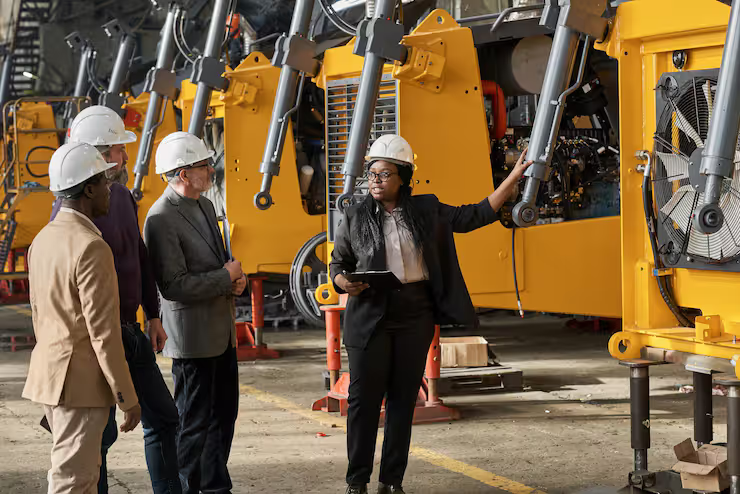
A typical manufacturing process may include:
- Product and mechanical design
- Computer-aided engineering and simulation
- Material selection
- Metal cutting and forming
- Welding and fabrication
- Precision machining
- Hydraulic and electrical integration
- Component assembly
- Software and control-system integration
- Quality inspection and performance testing
The goal is to create equipment that can perform demanding tasks while meeting appropriate safety, durability, and environmental requirements.
Main Types of Heavy Industrial Machinery
| Machinery Type | Common Applications |
|---|---|
| Excavators | Construction, mining, earthmoving |
| Bulldozers | Land preparation and infrastructure |
| Cranes | Lifting and material handling |
| Wheel loaders | Loading and transportation of materials |
| Industrial presses | Metal forming and manufacturing |
| Drilling machines | Mining, construction, and geological work |
| Agricultural machinery | Farming and land management |
| Material-handling equipment | Warehouses, factories, and logistics |
Why Heavy Machinery Manufacturing Matters Today
Heavy machinery is closely connected with infrastructure development and industrial productivity. Roads, bridges, ports, mines, factories, power facilities, and large construction projects depend on equipment capable of moving, lifting, cutting, drilling, or processing heavy materials.
Modern industrial machinery also helps address several operational challenges.
Supporting Industrial Productivity
Automation, sensors, hydraulic controls, robotics, and computerized systems allow machines to perform complex operations with greater consistency.
Computer-aided manufacturing and digital monitoring can also help manufacturers identify design or production problems earlier in the manufacturing cycle.
Improving Workplace Safety
Modern machinery increasingly incorporates protective systems such as emergency stops, interlocks, sensors, cameras, alarms, and machine guarding.
Safety is particularly important because heavy equipment contains powerful moving components that can create crushing, cutting, entanglement, and other hazards. OSHA states that machinery hazards should be controlled through appropriate safeguarding measures.
Supporting Energy and Environmental Goals
Manufacturers are increasingly examining fuel efficiency, electrification, emissions reduction, lightweight materials, and energy-efficient hydraulic and electrical systems.
This is particularly relevant for construction and mining equipment, where large machines can operate for long periods under demanding loads.
Connecting Mechanical and Digital Technologies
Heavy machinery is no longer based only on mechanical components. Modern equipment may combine:
- Industrial IoT sensors
- GPS and positioning systems
- Electronic control units
- Hydraulic control systems
- Machine vision
- Telematics
- Predictive maintenance software
- Remote equipment monitoring
- Data analytics
These technologies can provide information about machine condition, operating parameters, fuel or energy use, and maintenance requirements.
Recent Developments in Heavy Machinery Manufacturing
The heavy equipment industry has been experiencing greater integration of automation, electrification, connected technologies, and advanced manufacturing.
Automation and Digital Manufacturing
Manufacturers are using CNC machining, robotic welding, automated inspection, digital twins, and simulation tools to improve engineering and production processes.
Digital twins can represent equipment or manufacturing systems digitally, allowing engineers to examine performance and design scenarios before physical implementation.
Electrification
Battery-electric and hybrid power systems are receiving increasing attention, especially for applications where emissions, noise, or fuel consumption are important considerations.
Electrification is more technically challenging for extremely large machines because battery weight, charging infrastructure, operating duration, and power requirements must be considered together.
Connected Heavy Equipment
Sensors and telematics can collect information from equipment during operation. This can support condition monitoring and help identify abnormal operating patterns.
The increasing use of connected systems also makes cybersecurity and software reliability important considerations in machinery design.
Manufacturing Policy Developments
In India, the National Manufacturing Mission was announced in the Union Budget on February 1, 2025. The initiative focuses on areas including technology availability, product quality, manufacturing capabilities, and a stronger manufacturing ecosystem. It also identifies clean-technology manufacturing as an area of attention.
A government review published on April 2, 2025 highlighted the importance of the capital goods and heavy engineering sectors to India's industrial development and infrastructure.
India's Ministry of Heavy Industries also continues to maintain programs related to capital goods technology development, testing, certification, advanced manufacturing, and engineering capabilities.
Laws, Standards, and Policies Affecting Machinery Manufacturing
Machinery manufacturers must consider the regulations of the country where equipment is manufactured, installed, or operated. Requirements can cover machine design, worker safety, electrical systems, emissions, documentation, and conformity assessment.
India: Occupational Safety Requirements
India's Occupational Safety, Health and Working Conditions Code, 2020 became enforceable on November 21, 2025, according to India Code. The legislation includes provisions covering occupational safety, health, working conditions, factories, and responsibilities of designers, manufacturers, importers, and other parties.
Manufacturing organizations should therefore evaluate machinery-related risks alongside workplace safety requirements and applicable rules.
United States: OSHA Machinery Safety
In the United States, OSHA's machinery and machine-guarding requirements include 29 CFR 1910 Subpart O. The requirements address areas such as machine guarding and specific categories of machinery.
OSHA also identifies hazardous-energy control, commonly known as lockout/tagout, as an important part of machinery safety during servicing and maintenance activities.
European Union: Machinery Regulation
For equipment entering the European Union market, Regulation (EU) 2023/1230 is an important development. The regulation is scheduled to apply from January 20, 2027, with certain provisions applying earlier. An amendment adopted in 2026 also affects the regulatory framework.
International Machinery Safety Standards
ISO 12100:2010 provides principles and methodology for machinery risk assessment and risk reduction. It covers hazard identification, risk evaluation, risk reduction, and documentation of the safety process.
Regulatory requirements vary by machine type and market, so manufacturers should consult the applicable legislation and standards before finalizing a design.
Tools and Resources for Heavy Machinery Manufacturing
Several technical resources can help engineers, manufacturers, researchers, and students understand industrial heavy machinery manufacturing.
| Tool or Resource | Main Purpose |
| CAD software | 2D and 3D mechanical design |
| CAE software | Engineering simulation and analysis |
| CNC programming software | Machining process preparation |
| ERP platforms | Production and resource planning |
| Digital twin platforms | Equipment and process simulation |
| CMMS software | Maintenance planning and records |
| ISO 12100 | Machinery risk assessment guidance |
| OSHA resources | U.S. machinery safety information |
| India Code | Indian legislation and regulations |
| EUR-Lex | European Union legislation |
Useful resources include official government regulatory websites, engineering standards databases, technical documentation, manufacturing calculators, machine-design references, and educational materials from engineering institutions.
For machinery safety research, the OSHA machine-guarding resources provide information on guards, hazardous machine movements, and workplace protection.
Frequently Asked Questions
What is industrial heavy machinery manufacturing?
It is the engineering and production process used to create large machines for demanding industrial applications. It involves design, material selection, fabrication, machining, assembly, testing, and quality control.
What materials are commonly used in heavy machinery?
Structural steel, alloy steel, cast iron, aluminum, engineered plastics, rubber, copper, and specialized composite materials are commonly used. Material selection depends on strength, weight, wear resistance, temperature, corrosion, and operating conditions.
How is automation changing heavy machinery manufacturing?
Automation is increasing the use of robotic welding, CNC machining, automated inspection, sensors, digital twins, and computerized control systems. These technologies can improve consistency and provide better production data.
Why is machinery safety important?
Heavy machines contain powerful moving, rotating, lifting, and cutting components. Proper machine guarding, risk assessment, control systems, maintenance procedures, and operator protection help reduce exposure to mechanical hazards. OSHA identifies guarding as a fundamental measure for controlling machinery hazards.
What standards are relevant to machinery manufacturing?
The applicable standards depend on the machine and market. ISO 12100 is widely used as a framework for machinery risk assessment and risk reduction, while regional regulations such as OSHA requirements in the United States and EU machinery legislation may establish additional obligations.
Conclusion
Industrial heavy machinery manufacturing combines mechanical engineering, advanced materials, automation, electronics, hydraulics, software, and quality management to create equipment capable of performing demanding industrial tasks.
Recent developments are moving the sector toward connected equipment, automated manufacturing, electrification, digital engineering, and improved energy efficiency. At the same time, machinery safety and regulatory compliance remain essential parts of the design and manufacturing process.
For manufacturers, engineers, and students, understanding the complete machinery lifecycle—from design and material selection through fabrication, assembly, testing, operation, and maintenance—provides a useful foundation for understanding modern industrial equipment.